
What is Signatera™ CDx?
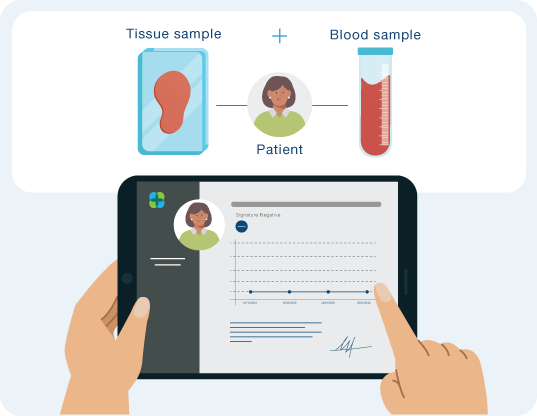
Signatera™ CDx is a personalized molecular residual disease, or MRD, blood test. It looks for small amounts of tumor DNA in the blood after surgery for muscle-invasive bladder cancer. The test is designed using your tumor tissue and a blood sample, so it is personalized to you.
Signatera™ CDx can help your doctor understand whether cancer may still be present at a level too small to be seen on scans and whether there may be potential benefit from Tecentriq® (atezolizumab).
How can this test help?
Signatera™ CDx can help support conversations with your doctor after surgery.
Is there cancer left in the body?
The test looks for tumor DNA in the blood that may suggest molecular residual disease after surgery.
Am I at higher risk of the cancer coming back?
A positive result may show a higher risk of recurrence and may help identify patients who could benefit from the treatment.
Should I keep monitoring over time?
Repeat testing can help your care team track your status over time and support follow-up decisions.
How does Signatera™ CDx work?
Step 1: Create your personalized test
Your doctor sends a sample of your tumor and a blood sample to create your custom test. This process takes about 3–4 weeks.
Step 2: Blood is collected over time
After your test is created, blood draws are used to assess ctDNA MRD over time. Blood draws may be completed in your doctor’s office, and mobile phlebotomy may also be available.
Step 3: Get your results
Results are typically available about one week after each blood draw. Your doctor will review your results with you and discuss what they may mean for your care.
What do the results mean?
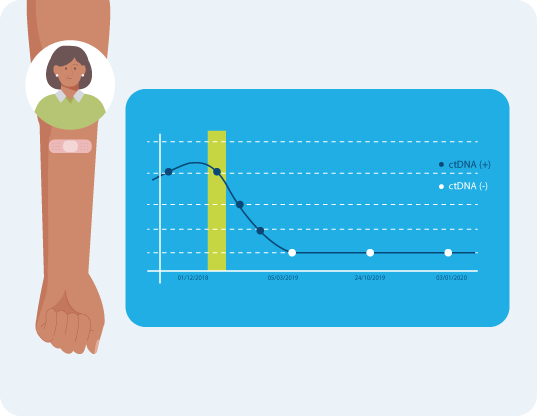
Your results will show whether tumor DNA was detected in your blood.
If your result is positive:
Tumor DNA was detected. This may mean there is a higher risk of the cancer returning. Your doctor may discuss whether additional treatment may be appropriate.
If your result is negative:
No tumor DNA was detected. This may mean a lower risk of the cancer returning. Your doctor may recommend continued monitoring over time.
Each result reflects a specific point in time, so repeat testing may be recommended.
Why ongoing monitoring may matter?
Cancer can return over time, even if scans are clear.
Regular testing may help detect changes earlier and allow your care team to respond sooner.
In clinical studies, this type of testing has been able to detect signs of cancer months before it appears on imaging scans.1
What does the clinical research show?
In a clinical study, patients whose cancer was detected through this type of testing and received treatment lived longer than those who did not.1
These findings support the use of this type of testing to help guide decisions about care after surgery.
Important things to know
A negative result does not necessarily mean cancer is not present. Results reflect the time point when the sample was taken, so repeat monitoring may be important. Your doctor will interpret your results together with scans, pathology, symptoms, and other clinical information.
Want more information?
Talk with your doctor about whether Signatera™ CDx may be appropriate for you.
1Powles T, et al. New England Journal of Medicine. 2025. https://doi.org/10.1056/NEJMoa2511885.