
Post-cystectomy decision-making lacks precision
Current approach
- ~50% of patients recur after cystectomy
- Clinicopathologic features have limited ability to detect residual disease
- Radiographic recurrence occurs late
With ctDNA (Signatera™ CDx)
- Detect molecular residual disease earlier
- Identify patients at high risk of recurrence
- Enable treatment decisions before radiographic relapse
Personalized, tumor-informed MRD detection
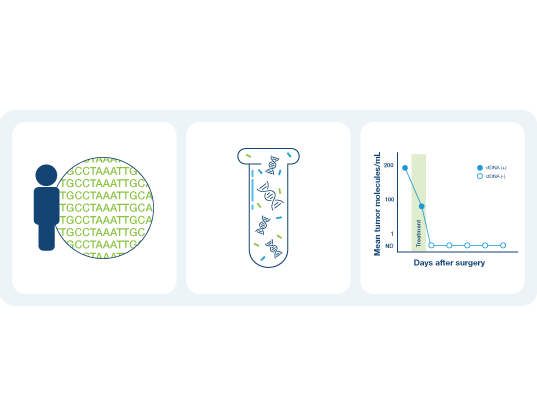
Signatera™ CDx is a personalized test designed from each patient’s tumor to detect circulating tumor DNA (ctDNA) in the blood. Longitudinal testing enables early detection of molecular residual disease and monitoring over time.
ctDNA status informs outcomes and treatment benefit
In the phase 3 IMvigor011 trial, ctDNA-guided treatment identified patients who derived benefit from adjuvant atezolizumab, while patients who remained ctDNA-negative had low risk of recurrence.8
Post-surgical baseline
HR 0.64
Improved disease-free survival with atezolizumab vs placebo in ctDNA+ patients
OS benefit
HR 0.59
Improved overall survival in ctDNA+ patients treated with atezolizumab
Early detection
42.6 months
MRD detection occurred up to 42.6 months (median 5.5 months) ahead of radiographic recurrence
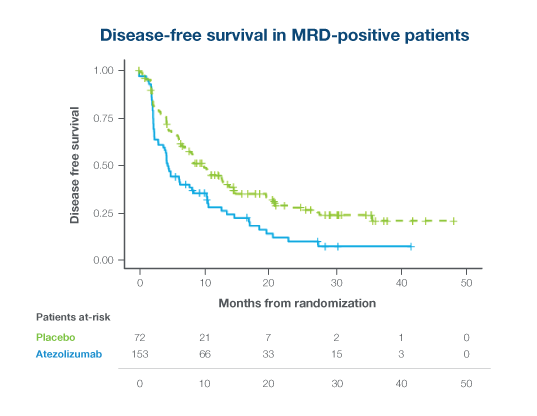
Treat at molecular relapse—not radiographic recurrence
IMvigor011 demonstrates that ctDNA-guided treatment enables earlier intervention in patients at highest risk of recurrence, while allowing patients who remain ctDNA-negative to avoid unnecessary treatment.
Integrating MRD testing into post-cystectomy care
Longitudinal ctDNA testing enables identification of patients at risk of recurrence and supports timely treatment decisions.

Post-surgical baseline
Establish MRD status after cystectomy

Longitudinal monitoring
Testing every 6 weeks for up to 1 year

Act on ctDNA positivity
Identify patients who may benefit from adjuvant therapy
Frequently asked questions
What does a positive result mean?
A positive result indicates detection of ctDNA, suggesting molecular residual disease and increased risk of recurrence.
What does a negative result mean?
A negative result indicates no ctDNA detected at that timepoint; continued monitoring is recommended.
*A negative result indicates that ctDNA was not detected at the time of testing and does not definitively indicate the absence of cancer. Results are specific to the timepoint assessed, and continued monitoring is recommended.
Explore broader MIBC evidence
1Powles T, et al. Nature. 2021;595(7867):432-437. https://doi.org/10.1038/s41586-021-03642-9.
2Svatek RS, et al. Canadian Urological Association Journal. 2009. doi: 10.5489/cuaj.1203.
3Christensen E, et al. Journal of Clinical Oncology. 2019. doi: 10.1200/JCO.18.02052.
4Powles T, et al. European Urology. 2023. https://doi.org/10.1016/j.eururo.2023.06.007.
5Bratman SV, et al. Nature Cancer. 2020;1(9):873-881.
6Powles T, et al. Presented at EAU Annual Conference, 2024.
7Natera Data on File as of May 1, 2024.
8Powles T, et al. New England Journal of Medicine. 2025. https://doi.org/10.1056/NEJMoa2511885.