
Prospera™ Liver
Built to surveil. Trusted to protect.
The newest evolution of Prospera™ is officially here.
We are proud to introduce Prospera™ Liver, marking a significant milestone as the first donor-derived cell-free DNA (dd-cfDNA) test commercially available for liver transplant recipients.
Built on the same industry-leading Prospera™ technology already trusted for kidney, heart, and lung patients, this new evolution brings our proven precision and advanced insights to liver transplant care.
How Prospera™ works
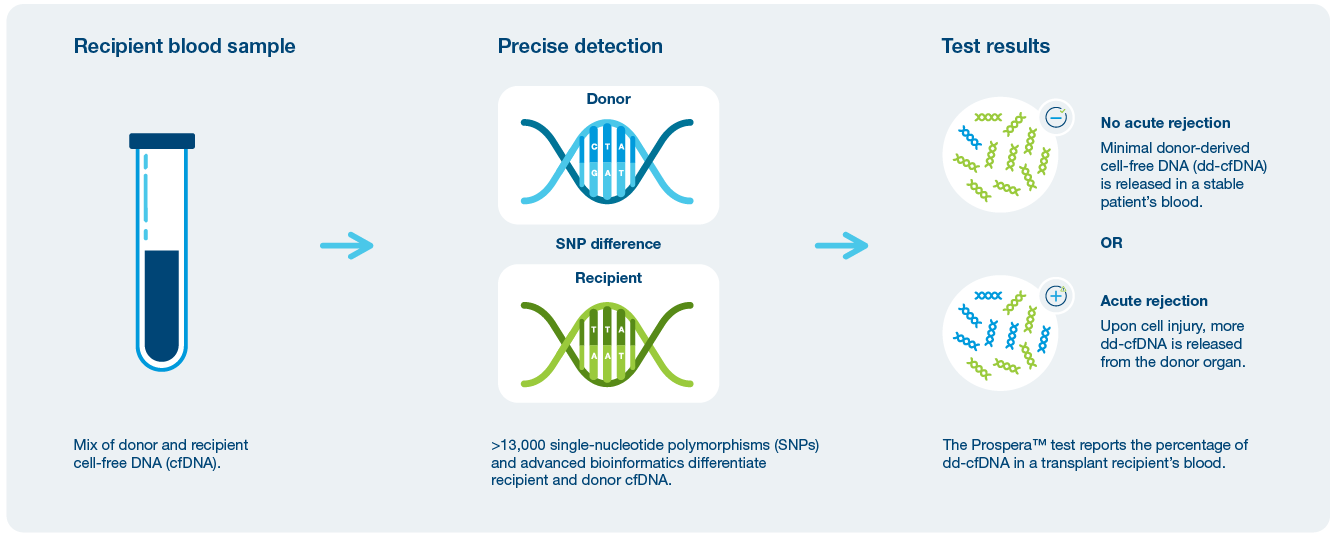
With a simple blood test Prospera™ evaluates the level of donor-derived cell-free DNA (dd-cfDNA) in a transplant patient’s blood to identify early signs of organ injury or rejection.1-3
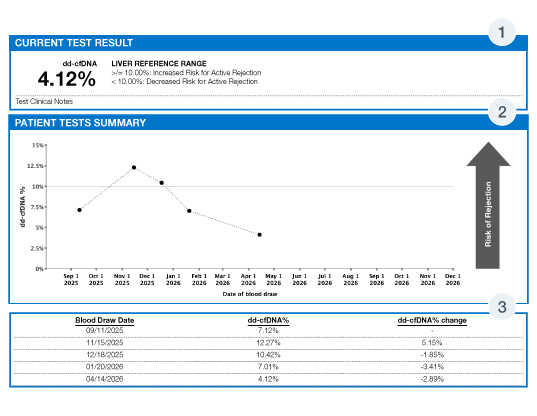
- Prospera™ Liver uses a donor fraction threshold of ≥10% to indicate active rejection.4,5,6
- dd-cfDNA fraction trends for ongoing surveillance of your patient’s long-term health.
- Chronological tracking of test results and risk to assist in care decisions.
Early insight means early action–and a better chance to protect the life a transplant makes possible
This deeper insight may help physicians:

Reduce the need for surveillance biopsies

Monitor changes in graft health over time

Focus attention where intervention may matter most
Find out more about Prospera™ for liver transplant recipients
References
1Sigdel TK, et al. Optimizing Detection of Kidney Transplant Injury by Assessment of Donor-Derived Cell-Free DNA via Massively Multiplex PCR. J Clin Med. 2018;8(1):19.
2Kim PJ, Olympios M, Siu A, et al. A novel donor-derived cell-free DNA assay for the detection of acute rejection in heart transplantation. J Heart Lung Transplant. 2022;41(7):919-927. doi:10.1016/j.healun.2022.04.002.
3Rosenheck JP, Ross DJ, Botros M, et al. Clinical Validation of a Plasma Donor-derived Cell-free DNA Assay to Detect Allograft Rejection and Injury in Lung Transplant. Transplantation Direct. 2022;8(4). doi:10.1097/txd.0000000000001317.
4Internal clinical validation data demonstrating the use of donor-derived cell-free DNA (dd-cfDNA) for the detection of liver allograft rejection has been submitted for publication.
5Schütz et al. Graft-derived cell-free DNA, a noninvasive early rejection and graft damage marker in liver transplantation: A prospective, observational, multicenter cohort study. PLoS Med. 2017;14(4):e1002286. doi:10.1371/journal.pmed.1002286.
6Deng et al. Donor-derived cell-free DNA as a noninvasive biomarker for diagnosis and monitoring of acute rejection after liver transplantation. Front Immunol. 2026;17:1769538. doi:10.3389/fimmu.2026.1769538.
For additional performance data, please call us at 650-273-4468 #3