
The latest Panorama™ reduces no-calls to 0.5%
Enhanced with novel SNP-informed deep sequencing technology, Panorama™ is backed by the first clinical validation specifically in patients with low fetal fractions.1
Highly accurate results for more patients
The SNP-informed deep sequencing technology in the latest Panorama™ provides results for patients with low fetal fractions.1 Results are automatically integrated into the existing workflow, with no additional sample required.

0.5%
overall no-call rate1

5-7
day turnaround is unchanged
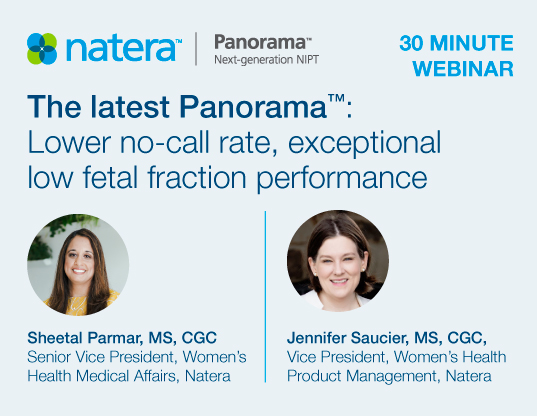
Featured webinar
Join Sheetal Parmar, MS, CGC and Jennifer Saucier, MS, CGC, to learn more about the latest Panorama™. In this webinar, you will:
- Learn about challenges with low fetal fraction and limitations of existing approaches to address them
- See the data supporting the latest version of Panorama™, including the clinical validation for performance in common aneuploidies in a low fetal fraction cohort
- Get an overview of Panorama™ reporting updates, including changes to atypical results reporting aimed to better support patient counseling for these types of results
Choosing an NIPT with clinically validated sensitivity is particularly important for patients with low fetal fraction
Patients with low fetal fractions have up to 10x higher risk of aneuploidy than patients with higher fetal fractions. Until now, there has been a data gap for clinical validation at low fetal fractions.2,3

Panorama™ is now the first and only NIPT to provide clinical validation data for common trisomies specifically in low fetal fraction patients.
Panorama™ is now the first and only NIPT to provide clinical validation data for common trisomies specifically in low fetal fraction patients.
Unprecedented clinical validation data for patients with low fetal fractions
| Sensitivity | Specificity | |
|---|---|---|
| Trisomy 21 | >99% (n=10/10) |
>99% (n=231/232) |
| Trisomy 18 | 93% (14/15) |
>99% (226/227) |
| Trisomy 13 | >99% (9/9) |
>99% (233/233) |
Is Panorama™ right for you?
We’re here to help you find out
References
1Internal data on file; abstract submitted for publication.
2Norton ME, et al. Obstetrical, perinatal, and genetic outcomes associated with nonreportable prenatal cell-free DNA screening results. Am J Obstet Gynecol. 2023 Sep, 229(3):300.e1-300.e9. doi: https://doi.org/10.1016/j.ajog.2023.03.026.
3Norton ME, et al. Cell-free DNA Analysis for Noninvasive Examination of Trisomy. N Engl J Med. 2015;372:1589-1597. doi: https://www.nejm.org/doi/10.1056/NEJMoa1407349.